

Comparing Energy Savings With Smart Thermostats vs. Traditional Thermostats
When it comes to controlling your home’s climate, the device on your wall plays a pretty large role. You might not think your thermostat matters, but it does. For decades, simple dial or push-button models were the standard. Today, however, sophisticated climate control devices offer a powerful new way to manage energy consumption. If you are considering an upgrade to your home’s HVAC system in the Mid-Atlantic region, comparing traditional models vs. modern climate controllers is a vital step. Our experts at McCrea Heating & Air Conditioning will walk you through a comparison and help you find your best option.
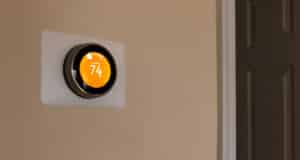
How Smart Thermostats Work
Modern climate controllers, called smart thermostats, go far beyond simply setting a temperature. These sophisticated devices connect to your home’s Wi-Fi network and use advanced processing power to analyze and respond to environmental factors. They represent a true shift from reactive temperature control to proactive energy management.
These devices don’t just read the temperature in your living room; they also gather data points from various sources. They track outdoor weather as well as your heating and cooling patterns and can learn when you leave and return home.
The key to their success is communication. By linking your heating and cooling system to the cloud, these devices allow for constant, real-time adjustments. If the temperature suddenly drops, a smart thermostat can respond instantly. It’s truly next-level home comfort.
Features That Improve Energy Efficiency
The advanced capabilities of these modern devices translate directly into better energy efficiency. When installed and set up correctly, they eliminate much of the energy waste that traditional systems are known for. McCrea Heating & Air Conditioning offers installation and setup options for the latest smart thermostats on the market.
These devices have several features that actively work to reduce your utility bills:
- Learning Capability: Automatically adjusts to your schedule over time
- Geofencing Technology: Detects when you leave and return home using your phone’s location
- Remote Control Access: Allows for temperature changes from anywhere via an app
- Usage Reports: Provide data on energy consumption patterns
- System Diagnostics: Monitor HVAC system health and performance
The ability to remotely control your climate from anywhere is a significant advantage. If you leave town unexpectedly, you can adjust the temperature down instantly from your phone. As you might imagine, there are numerous scenarios where this remote access would come in handy.
How Traditional Thermostats Operate
Traditional thermostats, whether analog or basic digital models, operate on a very simple principle. Basically, they measure the temperature in the immediate vicinity and activate the HVAC system when that temperature deviates from your set point. They are simple, reliable, but inherently limited in their intelligence.
These devices rely entirely on manual input. If you want the temperature to change, you must be physically present to turn the dial or press a button. They have no memory of past energy use, no connection to the outside world, and no understanding of whether the house is occupied or empty.
This old design, while great for its purpose, still leads to a lot of energy waste because users frequently forget to change their temperature settings.
Limitations That Affect Energy Use
While traditional models are more affordable and easier to install, their limitations impact your energy consumption. These limitations are precisely what makes an upgrade to a modern climate controller so appealing for homeowners.
The limitations that hurt your energy use include:
- No adaptation to schedule changes
- Inability to detect when the home is unoccupied
- Reliance on a single temperature sensor location
- No remote troubleshooting or diagnostic capability
- Inefficient use of heating/cooling cycles
Ultimately, a traditional thermostat is a passive device. It must wait for your input, or for temperature changes. This lack of intelligence means your system is solely reactive. Smart thermostats create proactive HVAC systems.
Comparing Long-Term Energy Savings
When comparing long-term energy savings, modern, internet-connected smart thermostats emerge as the clear winners. While the initial investment is higher than a basic model, the overall efficiency will result in a strong return on investment through reduced utility bills. This is our team at McCrea Heating & Air Conditioning strongly recommends upgrading to smart thermostats.
Independent studies consistently demonstrate that sophisticated climate controllers can reduce heating and cooling costs by 10% to 20%. This significant reduction is not achieved by simple programming, but through the constant learning and adaptation to your home’s unique profile.
Instead of letting your furnace run until the internal temperature reaches the set point, a smart thermostat might analyze the weather forecast and slightly reduce the temperature in anticipation. This precision minimizes runtime, which is the direct link to lower energy use.
Choosing the Right Option for Your Home
The choice between the two models depends entirely on your lifestyle and your energy goals. If you have a predictable, unchanging schedule and are diligent about manual adjustments, a traditional model might suffice. However, for most modern households, a sophisticated controller offers a bevy of benefits.
If you value convenience, seek maximum energy efficiency, and want the ability to monitor and control your climate from your phone, a modern device is the right choice. As a top HVAC contractor, McCrea Heating & Air Conditioning can help you assess your current HVAC system compatibility and recommend the ideal device for your home.
Making an Informed Thermostat Upgrade
The evolution of home climate control offers an opportunity to improve comfort while greatly cutting costs. While traditional models are simple and cheap, they cannot compete with the long-term, adaptive energy savings provided by a modern device. The ability of these systems to learn, adapt, and respond remotely makes them an essential tool for people concerned about their carbon footprint.
We are the residential and commercial HVAC contractor you can trust for all your climate control needs in the area. At McCrea Heating & Air Conditioning, we don’t just sell devices; we provide comprehensive HVAC services. Our services include heating repairs and air conditioning tune-ups, and so much more. We can ensure your system is perfectly compatible with a new smart thermostat for maximum efficiency.
Contact McCrea Heating & Air Conditioning today to learn more about our selection of smart thermostats and our thermostat installation and repair service options for customers in Virginia, Maryland, Pennsylvania and Delaware.
Frequently Asked Questions
There’s nothing complex about smart thermostats when we’re on the case. However, you may still have questions. Here are answers to some of the questions we are most commonly asked.
Do smart thermostats always save more energy than traditional models?
In most cases, yes. Modern thermostats save energy because they eliminate human error and manual waste. Their ability to adapt to real-time variables ensures less energy is wasted.
Can smart thermostats work with most HVAC systems?
Most modern climate controllers are compatible with most HVAC and heat pump systems. Before making an investment, it is always best to consult with us to verify compatibility with your specific system. We’ll help you find your best option.
What features should I look for when selecting a smart thermostat?
Remote control access via an app is the biggest option. You may also want geofencing capabilities and integration with other home automation systems. Overall, you want features that are clear and easy to use and help you to save energy.